In the simplest form, cognitive load theory (CLT) refers to the notion that we have limited capacity in our mind to hold information while we’re learning. A CLT researcher might be frustrated with me for making it sound so simple, because it’s definitely not simple. However, when you read through articles from Paas & van Merriënboer (2020) or Sweller (2020) sometimes the jargon used by cognitive psychologists and educational technology researchers gets in the way of practical application. Don’t get me wrong, I fully appreciate their ability to connect working memory and learning tasks with the individual needs of learners in their unique environments, but we also need quick strategies to turn this research into an instructional design framework.
Instructional design is a creative process whereby we employ the science of learning with the physiological structures of human beings while considering extraneous factors that are uncontrollable in the learner’s physical space and cognitive load…instructional design is a tough field.
I’ll share more about what I have learned from the previously mentioned researchers momentarily, but first I want to comment on Dr. Bror Saxberg, VP of Learning Science at the Chan Zuckerberg Initiative, and his ability to break down cognitive psychology into a 5-minute talk. I stumbled across Dr. Saxberg through a Google search on learning engineering (more on that later), but was struck by his ability to simplify complex cognitive neuroscience research and offer immediate guidance to educators in 2017 at the iNACOL Symposium (now called the Aurora Institute Symposium) on the need for individualized learning based on how our minds work and what motivates learners (Saxberg, 2017). In summary, human beings are systems (I’ve mentioned this before) with a working memory dealing with complex tasks and immediate needs being fed by information from our long term memory. There is a connection between these two functions of memory that we must pay attention to when crafting learning activities for our students — this is the cognitive side of the learning system, the structural components of how our brains work to help us remember and learn.
But on the other side, the motivation side, sits factors that influence why we start, persist, and put in any mental effort into the learning. We can impact the motivational side, but it is unique to every learner with questions coming up in their mind around “why can’t I learn this new material?” or “am I smart enough to do this?” or “what is the purpose of learning this? I’ll never use it!”. Saxberg references Richard Clark and his ideas on how we can problem solve around motivational issues, but in the end, the neuroscience points to the necessity of why learning must be personalized because individual students have individual motivational problems and what is present in the student’s long-term memory that enables their working memory to succeed is also different. Difference life experiences and backgrounds bring learners to the same table with very different starting points (Watch these videos Video 1 Video 2).
The reason I share this information from Saxberg is to consider the enormous complexities involved in constructing a learning experience for a room full of students with completely different lived experiences. That is the instructional design challenge. I am learning so much from my current course on instructional systems design, both from the discussions with my professor and classmates, but also because of the research we are exposed to as graduate students. It’s actually a strategy suggested by Saxberg to help students learn — give students worked examples ahead of time. This exposure, also suggested by Paas & van Merriënboer (2020) will help them see the end product and contribute less to their cognitive load freeing up more space to focus on the new learning within their working memory. Saxberg (2017) offers additional examples in his talk, it’s worth 6 minutes of your day.
CLT + ID = Support for all learners
I actually came across the Paas & van Merriënboer article when reading Groshell’s blog post on CLT and instructional design. He was able to take the strategies from the article and put it into a digital poster to help spread the word on CLT (image included below – spread it around!).
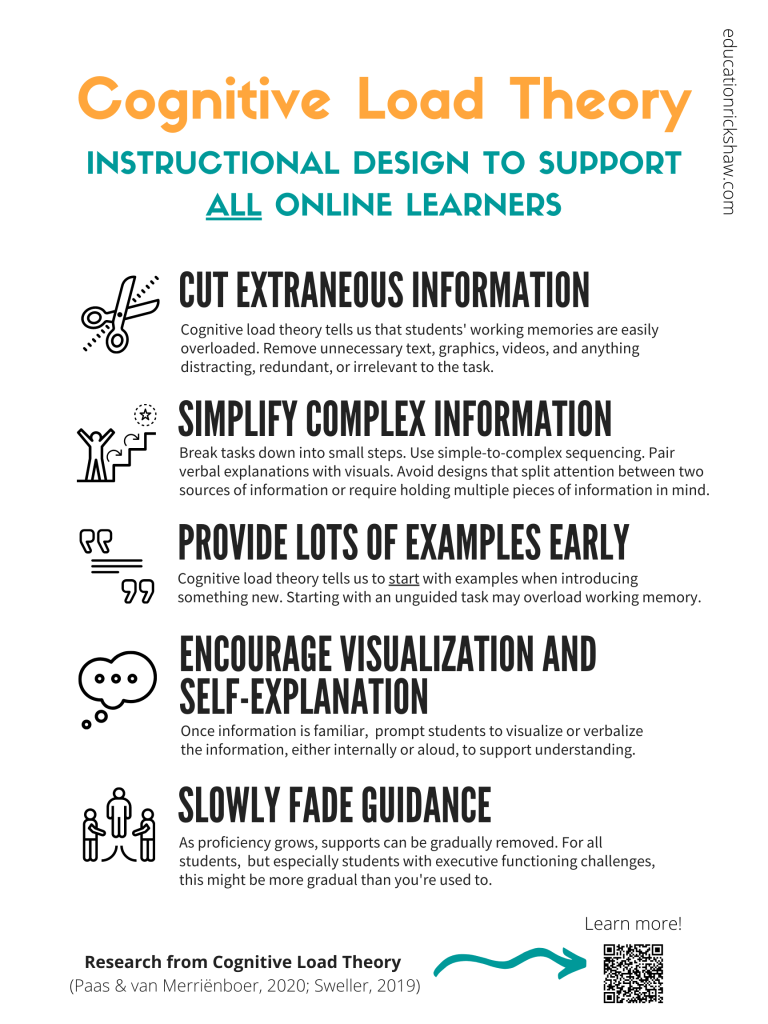
Pass & van Merriënboer discuss CLT in relation to three different components —
- the individual learner,
- the learning tasks, and
- the learning environment.
Each plays a role in contributing to either increased or decreased amount of working memory being used during a learning activity. It is the job of the instructional designer to craft an environment that permits the maximum amount of working memory to be spent on the learning task and not on extraneous cognitive load.
The Saas & Van Merriënboer article references Sweller (2020) and the application of CLT to educational technology. With the increased use of educational technology in instructional design, we need to proceed with caution to be sure the technology does not cause additional load on the learner’s working memory. The technology should be used to enhance the learning experience, not hinder it.
Do you see a theme here? There is so much being asked of instructional designers when crafting a learning experience, training session, or full course development — the learning theory behind it, the technology used to build it, the customer service skills required to work with a subject matter expert, and most importantly — the individual needs of the unique learners who will participate in the end product. This challenging field is becoming more and more necessary as higher education navigates a post-COVID instructional environment.
This is actually why I started researching learning engineering, as I mentioned earlier in this post, with a goal to understand the differences in the various job titles associated with the broad scope of the instructional designers role. My current role is shifting departments and we are attempting to document my role in educational technology as it fits within the course design team. As we consider the development of additional learning opportunities beyond just courses, learning engineering is a field that might be broad enough to capture the data collection & problem-solving skills at the front of the design as well as the creative process involved in crafting activities while also sitting in a system being utilized by teaching faculty and students with an ever-changing demographic. Stay tuned for more on how the new department shapes up.
Until next time, thanks for learning and reflecting with me.
References
Groshell, Z. (2021). Cognitive load theory, executive functioning, and instructional design. Retrieved from Education Rickshaw https://educationrickshaw.com/2021/02/08/cognitive-load-theory-executive-functioning-and-instructional-design/
Paas, F., & van Merriënboer, J. J. G. (2020). Cognitive-load theory: Methods to manage working memory load in the learning of complex tasks. Current Directions in Psychological Science, 29(4), 394-398. https://doi.org/10.1177/0963721420922183
Saxberg, B. (2017). The 6-minute Master’s in cognitive psychology. Retrieved from Summit Learning https://blog.summitlearning.org/2017/11/bror-saxberg-inacol/
Sweller, J. Cognitive load theory and educational technology. Education Tech Research Dev68, 1–16 (2020). https://doi.org/10.1007/s11423-019-09701-3
Videos on white privilege
- Video 1: The first time I saw white privilege explained to college-aged kids
- Video 2: A more recent example in an elementary-aged students
 heather zink. a learner.