Category: learning theory

  • Human connections and multimedia learning

    eLearning is now prevalent across K12, higher education, and corporate learning environments. EdTech companies have provided a multitude of options for these various sectors to select the appropriate presentation method for specific audiences. But not all eLearning platforms are created equal, nor do they all follow any sort of cognitive theory for improving learning based on the challenging user experience of some platforms.  EdTech providers and educators alike would serve their customers, i.e. the student/learner, better by considering Richard Mayer’s cognitive theory of multimedia learning. Mayer (2017) combined what we know of information processing theory and cognitive load theory, as well as dual coding theory, and applied it to the use of multimedia in the design of elearning experiences. His combination of these theoretical perspectives can assist teachers and instructional designers in crafting easy-to-digest learning units for students.

    Consider these assumptions.

    • Learning takes place in an active state whereby learners are filtering information, selecting specific information, organizing it, and then integrating that information with prior knowledge (information processing theory).
    • There are two separate channels to process information: auditory & visual (dual-coding theory).
    • Each of these channels has a finite capacity for receiving information (Sweller’s cognitive load theory).

    Mayer proposed 12 multimedia instructional principles based off these assumptions as part of his cognitive theory of multimedia learning (Mayer, 2017). These principles are grouped into 3 categories aimed at minimizing extraneous processing (processing needed that is unrelated to the learning objective), managing essential processing (needed to mentally represent the material), and fostering generative processing (making sense of the material).  I’ve been working on a training course using Articulate’s Rise360 platform for the last few weeks, and Mayer’s theory resonated with some of the benefits I’ve found in the platform but also brought to light some areas I need to examine in more depth as we consider revisions to the course. More specifically, the three principles that help to foster generative processing (helping learners to organize and integrate new information into working memory) could be used to improve this course.

    With a focus on generative processing, the human emotional connection to the material improves. Adding an audio component to several instructional widgets improves the encoding of the information. With several audio elements already part of the course, it’s worth reviewing the tone of the audio recording to ensure a personal approach. The personalization principle (Mayer, 2017) tells us that people learn better from multimedia lessons when words are spoken in a conversational style rather than a formal style. I personally relate to this principle as I prefer a more conversational nature to any video I watch, but never knew there was theory and research behind it. Reading Mayer’s 2017 article in the Journal of Computer Assisted Learning affirmed my decision to start this degree program with UNT — I have always felt that developing an emotional connection to the material helped me to learn and my students in past courses to retain the material better.

    Appealing to the nature of being human — the connections between people — helps us be better humans and helps us learn. We are meant to go through life with a community, Mayer’s cognitive theory of multimedia learning provides evidence that we still want to feel part of a human community even through elearning experiences…an entire research agenda could be developed off this one statement. The voice principle, whereby people learn better when the narration in multimedia lessons is a friendly human voice rather than a mechanical machine voice (Mayer, 2017), confirms my prior experience as well. I think about how using a Powtoon video to draw or write out examples in the training course while speaking to the examples might help with encoding over just providing a picture of a completed example. Helping learners to organize information into existing schemas, connecting the information to prior learned material — this is where the instruction leads to learning and application.

    One final comment on how I might use Mayer’s principles in this training course relate to symbols and imagery. My client is looking to improve the iconography used within the training course to give the material a lasting impression with learners. The course is training individuals on a framework used to organize projects, and the framework contains five phases. Each phase is currently identified using a simple icon. The multimedia principle Mayer explains states that people learn better from words and pictures than just words alone. Adding a word near the icon/image may help with retention of the information in the course. Working with the marketing department or one of the instructional technologists who has experience in graphic design might be a good next step here.

    Future Research

    Even with lessons designed to reduce extraneous processing and activities focused on simplifying essential processing, tapping into the social element of the learning experience is still critical to get learners motivated to continue learning. Mayer’s generative processing principles dig further into this aspect of learning. Social cues in the lessons help the learner to see the instructor/facilitator as a partner. Using voice instruction in a friendly, conversational tone helps the learner develop a social partnership (Mayer, 2017) which can ultimately lead to better outcomes. We can use on-screen agents to increase the social nature of eLearning experiences. And while Mayer has helped get us started, there is vast opportunity for additional research in the application of the lab-designed principles he has postulated. Examining the role of motivation in multimedia learning is an area of interest for me. I need to look further into Moreno’s cognitive affective theory of learning with media.

    Until next time, thanks for learning and reflecting with me.

    References

    Mayer, R. E. (2017). Using multimedia for e-learning. Journal of Computer Assisted Learning, 33(5), 403–423.  https://doi-org.libproxy.library.unt.edu/10.1111/jcal.12197
  • Cognitive load theory & instructional design

    In the simplest form, cognitive load theory (CLT) refers to the notion that we have limited capacity in our mind to hold information while we’re learning. A CLT researcher might be frustrated with me for making it sound so simple, because it’s definitely not simple. However, when you read through articles from Paas & van Merriënboer (2020) or Sweller (2020) sometimes the jargon used by cognitive psychologists and educational technology researchers gets in the way of practical application. Don’t get me wrong, I fully appreciate their ability to connect working memory and learning tasks with the individual needs of learners in their unique environments, but we also need quick strategies to turn this research into an instructional design framework.

    Instructional design is a creative process whereby we employ the science of learning with the physiological structures of human beings while considering extraneous factors that are uncontrollable in the learner’s physical space and cognitive load…instructional design is a tough field.

    I’ll share more about what I have learned from the previously mentioned researchers momentarily, but first I want to comment on Dr. Bror Saxberg, VP of Learning Science at the Chan Zuckerberg Initiative, and his ability to break down cognitive psychology into a 5-minute talk. I stumbled across Dr. Saxberg through a Google search on learning engineering (more on that later), but was struck by his ability to simplify complex cognitive neuroscience research and offer immediate guidance to educators in 2017 at the iNACOL Symposium (now called the Aurora Institute Symposium) on the need for individualized learning based on how our minds work and what motivates learners (Saxberg, 2017). In summary, human beings are systems (I’ve mentioned this before) with a working memory dealing with complex tasks and immediate needs being fed by information from our long term memory. There is a connection between these two functions of memory that we must pay attention to when crafting learning activities for our students — this is the cognitive side of the learning system, the structural components of how our brains work to help us remember and learn.

    But on the other side, the motivation side, sits factors that influence why we start, persist, and put in any mental effort into the learning. We can impact the motivational side, but it is unique to every learner with questions coming up in their mind around “why can’t I learn this new material?” or “am I smart enough to do this?” or “what is the purpose of learning this? I’ll never use it!”. Saxberg references Richard Clark and his ideas on how we can problem solve around motivational issues, but in the end, the neuroscience points to the necessity of why learning must be personalized because individual students have individual motivational problems and what is present in the student’s long-term memory that enables their working memory to succeed is also different. Difference life experiences and backgrounds bring learners to the same table with very different starting points (Watch these videos Video 1 Video 2).

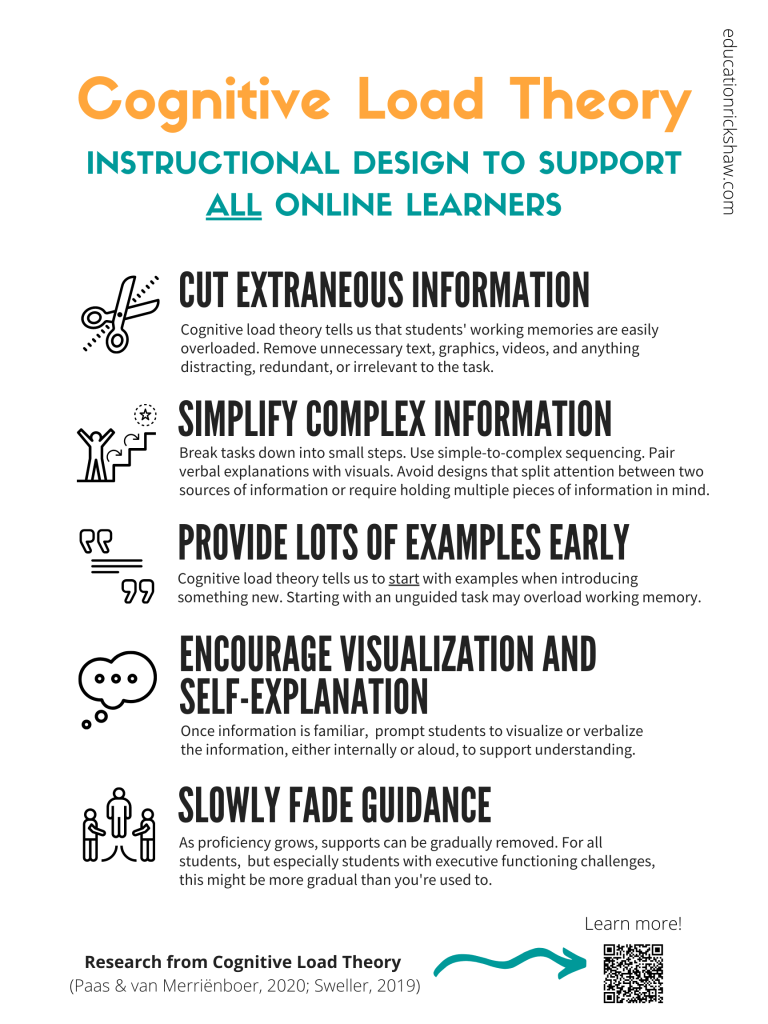
    The reason I share this information from Saxberg is to consider the enormous complexities involved in constructing a learning experience for a room full of students with completely different lived experiences. That is the instructional design challenge. I am learning so much from my current course on instructional systems design, both from the discussions with my professor and classmates, but also because of the research we are exposed to as graduate students. It’s actually a strategy suggested by Saxberg to help students learn — give students worked examples ahead of time.  This exposure, also suggested by Paas & van Merriënboer (2020) will help them see the end product and contribute less to their cognitive load freeing up more space to focus on the new learning within their working memory. Saxberg (2017) offers additional examples in his talk, it’s worth 6 minutes of your day.

    CLT + ID = Support for all learners

    I actually came across the Paas & van Merriënboer article when reading Groshell’s blog post on CLT and instructional design. He was able to take the strategies from the article and put it into a digital poster to help spread the word on CLT (image included below – spread it around!).

    Pass & van Merriënboer discuss CLT in relation to three different components —

    • the individual learner,
    • the learning tasks, and
    • the learning environment.

    Each plays a role in contributing to either increased or decreased amount of working memory being used during a learning activity. It is the job of the instructional designer to craft an environment that permits the maximum amount of working memory to be spent on the learning task and not on extraneous cognitive load.

    The Saas & Van Merriënboer article references Sweller (2020) and the application of CLT to educational technology. With the increased use of educational technology in instructional design, we need to proceed with caution to be sure the technology does not cause additional load on the learner’s working memory. The technology should be used to enhance the learning experience, not hinder it.

    Do you see a theme here? There is so much being asked of instructional designers when crafting a learning experience, training session, or full course development — the learning theory behind it, the technology used to build it, the customer service skills required to work with a subject matter expert, and most importantly — the individual needs of the unique learners who will participate in the end product. This challenging field is becoming more and more necessary as higher education navigates a post-COVID instructional environment.

    This is actually why I started researching learning engineering, as I mentioned earlier in this post, with a goal to understand the differences in the various job titles associated with the broad scope of the instructional designers role. My current role is shifting departments and we are attempting to document my role in educational technology as it fits within the course design team. As we consider the development of additional learning opportunities beyond just courses, learning engineering is a field that might be broad enough to capture the data collection & problem-solving skills at the front of the design as well as the creative process involved in crafting activities while also sitting in a system being utilized by teaching faculty and students with an ever-changing demographic. Stay tuned for more on how the new department shapes up.

    Until next time, thanks for learning and reflecting with me.

    References

    Groshell, Z. (2021). Cognitive load theory, executive functioning, and instructional design. Retrieved from Education Rickshaw https://educationrickshaw.com/2021/02/08/cognitive-load-theory-executive-functioning-and-instructional-design/

    Paas, F., & van Merriënboer, J. J. G. (2020). Cognitive-load theory: Methods to manage working memory load in the learning of complex tasks. Current Directions in Psychological Science29(4), 394-398. https://doi.org/10.1177/0963721420922183

    Saxberg, B. (2017). The 6-minute Master’s in cognitive psychology. Retrieved from Summit Learning  https://blog.summitlearning.org/2017/11/bror-saxberg-inacol/

    Sweller, J. Cognitive load theory and educational technology. Education Tech Research Dev68, 1–16 (2020). https://doi.org/10.1007/s11423-019-09701-3

    Videos on white privilege

    • Video 1: The first time I saw white privilege explained to college-aged kids
    • Video 2: A more recent example in an elementary-aged students
  • Personal Learning Theory

    Learning is a process by which new knowledge or skill is acquired through experience and/or instruction or where prior knowledge is expanded or improved. While this definition feels more general, the actual learning process for human beings occurs both within an interconnected network system and serves as a component of the same system, driven by cognitive and physiological processes as well as social and cultural constructs (Goldstein, 2019).  Driscoll (2002) offers a framework to help instructors understand how learning occurs in order to drive effective instructional practices, especially as we consider the use of technologies within the learning environment in the 21st century –

    • Learning occurs in context.
    • Learning is active.
    • Learning is social.
    • Learning is reflective.

    These principles, along with the physiological components of learning and systems theory, have shaped my personal learning theory.

    Humans as a System

    Human beings are highly complex organisms with a built-in capacity for learning.  The human nervous system consists of neurons and organs connected to form the basis for sensory inputs and reactions to these various inputs. As humans interact in the environment, sensory processing encodes information into units able to be processed from short-term memory into long-term memory (Goldstein, 2019). As sensory inputs enter the brain through various avenues, stronger encoding usually results in a neural pathway involving the amygdala. LeDoux (2002) was among the first to start examining how emotion impacts memory from a physiological sense. Phelps (2004) affirms that encoding is stronger when accompanied by an emotional response through investigation into the hippocampal complex and its role in episodic memory, the human basis for past events. Neuroimaging studies demonstrate activity correlating the memory-enhancing effects of the emotion-based system in the amygdala and the memory-based system in the hippocampus (Dolcos, LeBar, & Cabeza, 2006). An improved understanding of these organs aids in the conclusion that the facilitation of attention and emotion during the learning process will improve recall in the future, proof that the learning took place initially.

    Human affective processes are integral to learning. Op’t Eynde & Turner (2006) use dynamical systems theory to interweave the cognitive, emotional, and motivational processes of learning. As the human is central to this process, they are both contributing to the system as much as they are receiving from the system. The learner’s prior knowledge contributes to what is learned today. As they learn, they are then contributing to the learning community.

    Community of Inquiry

    Learning occurs within an individual as they participate as an active member of a community. An instructor must be present to help shape and guide what is to be learned, even if the student is the instructor. Meaning is being constructed within the learning experience as the student actively participates, either alone or with others. These conditions are the basis for the Community of Inquiry framework developed by Garrison, Anderson, and Archer (2000). The three essential components that foster learning are a teaching, social, and cognitive presence. These are also components of an interconnected system where the presence of each informs the other. To impart meaning on new knowledge, the learner is present with their whole self – which includes the social nature of their emotions driven by both immediate and broader social-historical context.

    Personal Reflection

    As I reflect on my own learning experiences and how they have shaped my personal learning theory, I have always been both fascinated by and curious about the human body. From my work as a medical technologist understanding how lab tests determined the state of a healthy or ill individual, I have been searching for answers in how our bodies function and help us do our work. My most impactful learning experiences were those where I was given the autonomy to explore my own path and dig further into a topic of interest. Personal interest drives motivation, and this stems from the influence of supportive instructors. Real world application and multiple opportunities to interact with new content have helped new information stick in my brain, thus contributing to lasting learning and the desire to continue my learning journey.

    Summary

    The process of learning combines cognitive psychology and neuroscience research with an emotion connection driven by an engaged instructor. The learner is both a recipient of and contributor to a learning community or system, and both are impacted and changed by the presence of the other. The more opportunities we have to apply new knowledge in the context of real-world problems, the more likely we are to continue down a path of lifelong learning. Curiosity drives innovation and innovation forges human growth and connection.

    References

    Dolcos, F., LaBar, K. S., & Cabeza, R. (2006). The memory enhancing effect of emotion: Functional neuroimaging evidence. In B. Uttl, N. Ohta, & A. L. Siegenthaler (Eds.), Memory and emotion: Interdisciplinary perspectives. (107–133). Blackwell Publishing. https://doi-org.libproxy.library.unt.edu/10.1002/9780470756232.ch6

    Driscoll, M. (2002). How people learn (and what technology might have to do with it). ERIC Digest, ERIC Identifier: ED470032.

    Garrison, D. R., Anderson, T., & Archer, W. (2000). Critical inquiry in a text-based environment: Computer conferencing in higher education model. The Internet and Higher Education, 2(2-3), 87-105.

    Goldstein, B. (2019). Cognitive Psychology. 5th ed. California. ISBN: 9781337408271.

    LeDoux, J. E. (2002). Emotion, memory and the brain. Scientific American Special Edition, 12(1), 62-71. https://doi.org/10.1038/scientificamerican0402-62sp

    Op’t Eynde, P., & Turner, J. E. (2006). Focusing on the complexity of emotion issues in academic learning: A dynamical component systems approach. Educational Psychology Review, 18(4), 361-376. https://doi.org/10.1007/s10648-006-9031-2

    Phelps, E. A. (2004). Human emotion and memory: Interactions of the amygdala and hippocampal complex. Current Opinion in Neurobiology, 14(2), 198-202. https://doi.org/10.1016/j.conb.2004.03.015