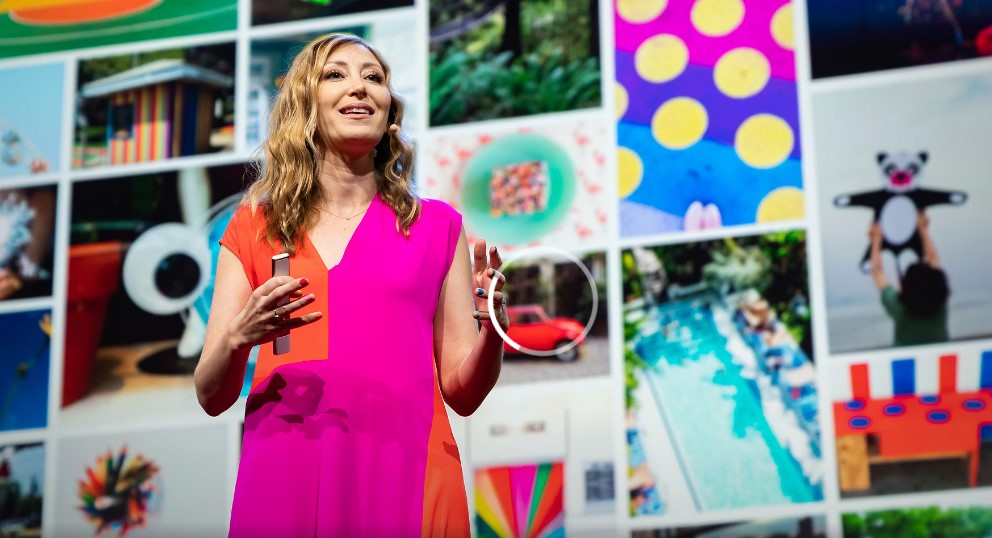
Good design is user-centered, no matter the product (Ruiz, Serral, & Snoeck, 2021). When it comes to designing mobile applications, designers must consider a smaller user interface (UI) that offers similar functionality to a desktop version of the same application. At the same time, mobile users are not always interested in the same features. Function aside, the visual experience for the mobile user is most definitely part of the choice to use one app over another. Designers must also consider the form or fashion elements of the mobile UI. In her 2018 TED Talk, Ingrid Lee, designer and self-identified joy-spotter, discusses the importance of finding joy in design and that tangible parts of our environment can lead to more joy in our lives.
Lee’s research into physical objects that lead to joy tells us that confetti and sprinkles are joyful, as are symmetrical objects like snowflakes or pops of color from rainbows. Some of this connects back to our evolution as human beings finding nourishment in ripe, colorful fruits in the treetops (Osorio & Vorobyev, 1996). What designers can take from this research is the fact that human beings are in search of joyful experiences, and with the choice of so many apps for the same types of function, the UI design must create a welcoming experience to be successful.
Apple Weather: Good balance between function & fashion
While only receiving a 3.8 out of 5 stars rating, Apple’s Weather app is a great example of joyful, thoughtful design with high functionality. The simplicity of the UI provides information about the weather for the day without overwhelming imagery. The icons used to depict various types of weather are commonly used across the web and the font choice is sans serif leading to improved accessibility. The playful nature of the graphics for various types of weather provides an immersive user experience. When it’s raining outside, it’s raining in the app with the details listed on top of the weather imagery. Even the screen that enables the user to see multiple cities at once has animated weather from each city. The high/low temperature menu was also recently updated to provide a more graphical display of the temperature with appropriate color used to signify cooler versus warmer temperatures. Apple designers are well-versed in color theory and joyful design. While ratings may not be high for the level of detail some users are seeking from a weather app (from only 666 ratings), users continually return to Apple’s Weather as a choice for visual appeal and easy-to-find weather information.

Amazon Shopping: Poor balance between fashion and function
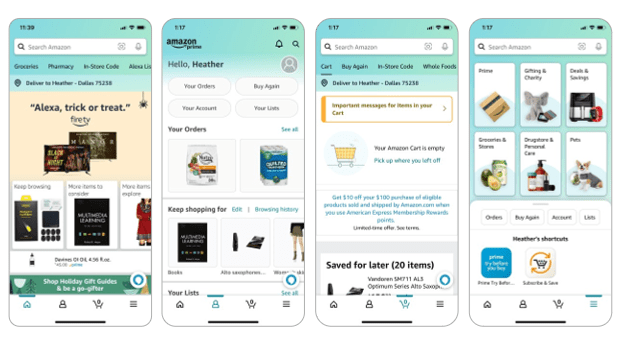
With 4.6 million ratings, Amazon Shopping receives a 4.8 out of 5 stars. It is obvious from the screenshots displayed in the App Store that Amazon has prioritized function for mobile users in the form of shipping notifications, changing your password, visual search features while in a store, and live chat support. These are important features for users on-the-go. However, the UI design follows no logical pattern for color theory with an aqua/minty blue green used in spots with brown packaging also mixed in. The opening screen has too many choices for users on such a display it is difficult to know where to start and users may become too distracted and not remember why they even opened the app in the first place. The icon choices have no words and are not intuitive for a novice user to know where to start unless you are simply looking to search Amazon for products. Sharp edges and too many visual menus do not meet the previously mentioned joyful design standards.
References
Osorio, D., & Vorobyev, M. (1996). Colour vision as an adaptation to frugivory in primates. Proceedings of the Royal Society: Biological Sciences, 263(1370), 593-599. https://doi.org/10.1098/rspb.1996.0089
Ruiz, J., Serral, E. & Snoeck, M. (2021). Unifying functional user interface design principles. International Journal of Human–Computer Interaction, 37(1), 47-67. https://doi.org/10.1080/10447318.2020.1805876
 heather zink. a learner.
Leave a comment