“Learning is a psychological task.”
My professor, Dr. Scott Warren, made this statement in our Zoom class this week. It fits directly with my personal learning theory shared previously in that learning is only achieved through cognitive processes of the individual learner. Each learner is unique, yet has similar physiological and social constructs that either assist or hinder their learning. Ultimately, the goal of instructional design is to create meaningful learning experiences with the individual learner in mind. When we consider the unique presence each learner brings to the experience and how learning occurs best within a known context, authentic assessments can be a rewarding activity for the learner to complete and not just a task they need to check off. We learn when we engage with material in an meaningful way, and by creating assessments of learning in which the learner authentically demonstrates their understanding, the instructional system becomes most successful.
Analysis of an instructional problem
This week in our Instructional Systems Design course, we are working through the analyze phase of the ADDIE model. While I’ve built training in the past and taught various courses, I have not utilized specific analysis strategies or questions to gather the necessary information at the start of a project. Our text (Piskurich, 2015) provided numerous assessment options, including a performance gap analysis and a training needs assessment tool. I utilized the following questions in my initial research —
- What do learners they need to know that they are not currently learning?
- What is the instructor’s philosophy of learning (how do they think people learn/how should they teach)?
- What does the instructor need help with teaching?
- What environmental affordances are in the learning environment that limits what can be done to improve learning and what can be used to improve it?
- What specific learning objectives should the training focus on?
- What types of instructional technologies are best suited for this type of instructional that will support learning?
I am working with a colleague who manages the project management office (PMO) at the university who needs to implement a project lifecycle framework for all university projects. Various department representatives could serve as a project manager for either their department or for the university initiative. These individuals usually have limited understanding of project management strategies and need a crash course in how the university organizes and prioritizes projects, as well as how funding, human, and IT resources are approved for the initiative. Her ultimate goal is to provide an overview of each phase of the project lifecycle framework to assist individuals in completed a Project Roadmap document. This document is used to submit various requests to committees, but also helps track all parts of the project in Smartsheet. Smartsheet is used to create dashboards for leadership to track projects and assign resources appropriately.
There are usually two groups of people who need support through the PMO — department heads needing a project manager or members of university committees assigned as a project manager for an initiative. A training course on the project lifecycle could transition an office of three people to more of a consultation office as opposed to project management office. In thinking through the ultimate goal of the training, assisting individuals in completed the Project Roadmap document makes the most sense for a summative assessment — and bonus, it’s an authentic assessment! The course can be separated into short modules focused on individual phases of the project lifecycle, each module ending with the completion of a component of the Project Roadmap. Moving from knowledge of the individual phases into immediate application of this information to their own project will help the learner retain this knowledge for future projects.
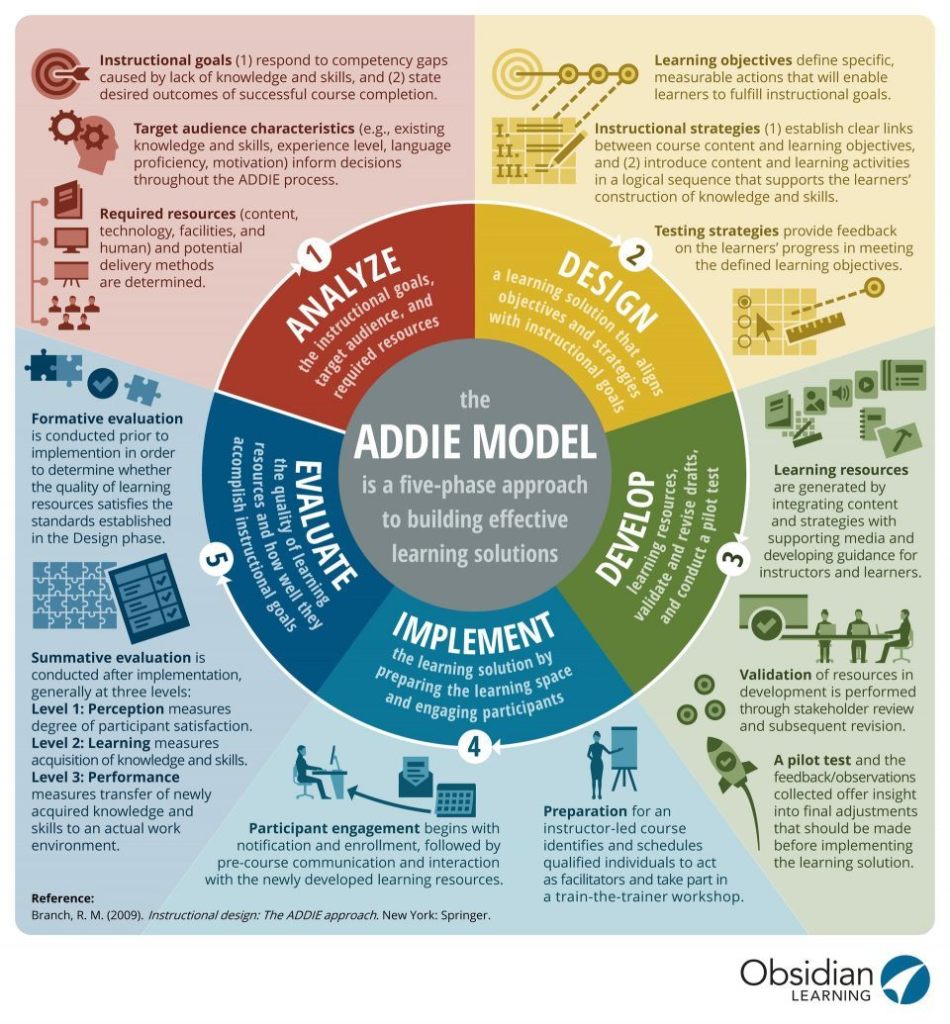
The infographic above captures beautifully the process I’ve started with my colleague. Identifying the target audience took two meetings to finalize. Initially, we thought an overview video for those interested in a high-level understanding of the lifecycle would suffice. But the more conversation we had, it became evident that the true need was to support these folks who had limited understanding of project management techniques but were being asked to manage projects. How could we support them better and assist them in drafting the Project Roadmap at the same time? I’m excited to start designing the individual modules that enable the learner to acquire the knowledge they need and then immediately apply it to their specific project.
Connecting Analysis & Design
Nichols Hess & Greer (2016) documented their personal experience with utilizing the ADDIE model to redesign an online information literacy course, as non-instructional designers. They spent considerable time reviewing problems with the past coursework, understanding instructional design theory and process, as well as gathering data from past courses as part of the analysis phase. Analysis should be where instructional designers spend a good deal of their time in working with subject matter experts (SMEs). In this particular case, the designers were also the SMEs which can be both an asset and a detriment. This combined role could result in a poor analysis of the true problems needing to be solved if the problems are not identified correctly. Piskurich (2015) recommends having other instructional designers review the analysis and design documents. A non-bias set of eyes can poke holes and ask additional questions to ensure your design is meeting the analysis, and to be objective about what the true problems are needing solved. Without the analysis component, time and money are wasted on developing instruction or training that may not be needed.
With the analyze phase being so critical, I found it interesting that the iDesign IDEA book presented limited information on how and why this phase cannot be missed. This book was introduced to me through the EDUCAUSE Learning Technology Leaders Institute that I completed this spring. The book serves as a crash course in instructional design with resources focused heavily on the design and development aspects of the ID process. It clearly indicates (even in the title of the company) that the book has been created to assist faculty in designing learning experiences. As an open educational resource, it serves to promote quality instructional practices in order to create learning experiences that have a lasting impact on the learner. It’s truly a phenomenal resource. However, without enough focus on analyzing specific characteristics of the learners, the design might miss key aspects of what a learner might need to know. There is a specific section of the book dedicated to writing learning objectives, but without an analysis of the learning problem to be solved by the course and clear picture of the overall learning goals, the objectives may not accurately reflect the needs of the learner. While I have provided a critique of this particular aspect of the book, I cannot recommend the iDesign IDEA book enough for any higher ed faculty member looking for design strategies as they consider transitioning from a primarily campus-based course to a blended model for instruction this fall.
Summary
We know learning takes place with the individual learner as a cognitive process. Human cognition takes place within the brain. In order to design effective learning activities, we need to know how the brain works. The brain has a section dedicated to visual elements, a section for auditory components, a section that focuses primary on the affective domain of learning (obviously I’m oversimplifying here). These structures combine past learning with the individual’s current state to help the individual be ready to learn. Instructional designers play a role in helping the learner feel safe and comfortable at the start of the learning process. A thorough analysis of the learning problem can lead to the design of a safe learning environment for any learner to thrive.
Until next time, thanks for learning and reflecting with me.
References
Nichols Hess, A., & Greer, K. (2016). Designing for engagement: Using the ADDIE model to integrate high-impact practices into an online information literacy course. Communications in Information Literacy, 10 (2), 264-282. https://doi.org/10.15760/comminfolit.2016.10.2.27
Piskurich, G. M. (2015). Rapid instructional design: Learning ID fast and right (3rd ed.). San Francisco, CA: Pfeiffer. ISBN-13: 978-1118973974
 heather zink. a learner.
Leave a comment